
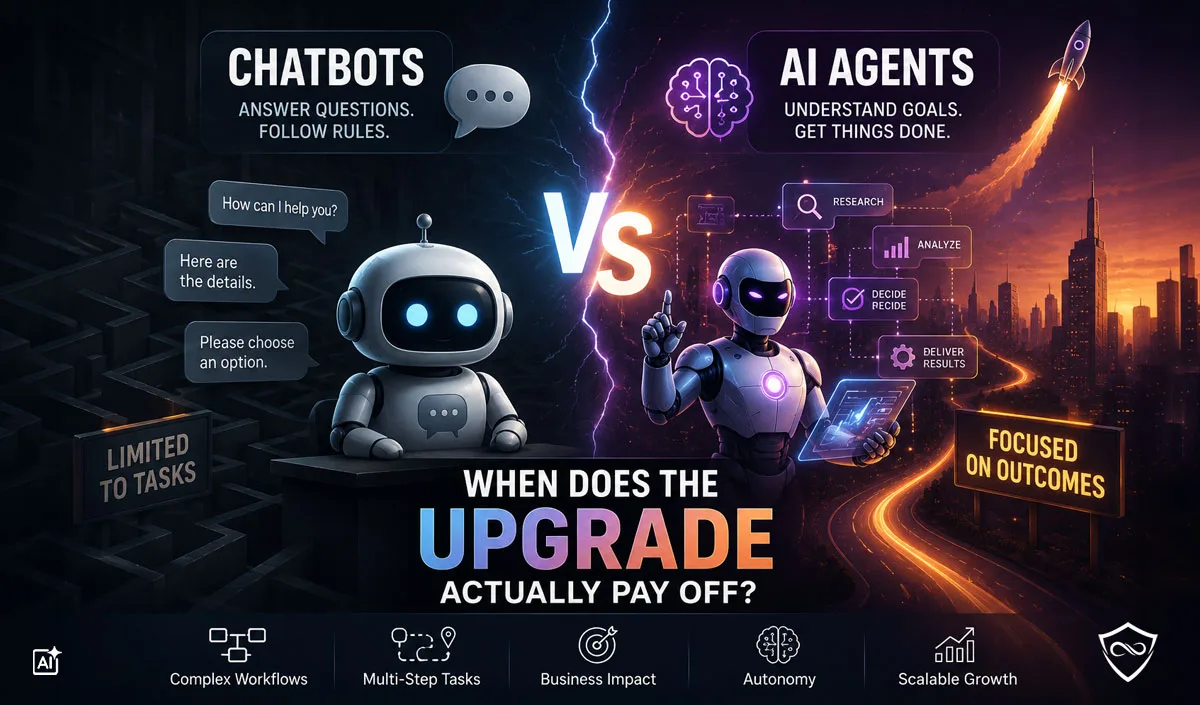
This quarter, nearly every SaaS and services founder we spoke with has received pitches for "AI agents." The message is consistent: chatbots are outdated, agents are the future, and upgrades are necessary. While some pitches are justified, others propose a Rs 15 lakh agent for tasks a Rs 2 lakh chatbot could handle.
This post provides a clear decision framework: when agents outperform chatbots, when chatbots remain the better choice, and three real scenarios from our build queue where outcomes differed from founder expectations.
The one-line difference
A chatbot answers questions. An agent takes actions.
A chatbot for a SaaS product provides instructions, such as "here is how to invite a teammate: go to Settings, click Members, click Invite." An onboarding agent monitors activation events and, if no invite occurs within 48 hours, sends a Slack notification to the customer, drafts the invite email, updates the CRM lifecycle stage from "activated" to "team_forming," and notifies the assigned CSM for accounts above a specific ARR threshold.
A chatbot requires prompt engineering, while an agent involves a decision graph with memory, tool integrations, retries, and human escalation paths. This difference explains the gap in build cost and potential returns. When chatbots still win
Avoid upgrading to an agent when a chatbot is the appropriate solution. Here are four situations where a chatbot is the honest answer:
Q&A on documentation, policy, or product
If 80 percent of user queries are "how do I," "where is the," or "what is the difference between," a RAG chatbot with paragraph-level citations addresses these efficiently and cost-effectively. Adding agent orchestration to a pure Q&A workload increases latency and cost without providing additional value.
Read-only workflows
For tasks such as order status, appointment lookup, invoice retrieval, or knowledge base search, if users only require information the system already possesses, an agent is unnecessary. A well-configured RAG bot with direct database access completes these tasks efficiently.
Regulated environments where every action needs sign-off
If poIf policy mandates human approval for every significant action, agent autonomy is limited. In many BFSI compliance workflows, human review time dominates, making agent orchestration inefficient. A chatbot that drafts and hands off tasks is often more suitable.l conversation volume
With fewer than 200 conversations per day, the fixed costs of agent infrastructure are difficult to justify. Build the chatbot first, validate conversation volume, and consider upgrading later.
When agents beat chatbots outright
Upgrading to an agent is cost-effective only when all three conditions are met.
The workflow needs 3 or more steps. Read something, check something, decide something, write something back.
The workflow should span at least two tools, such as CRM and Stripe, ticketing and analytics, or calendar, email, and billing systems.
The central decision must be valuable to automate, such as determining refunds, upsells, or escalations—tasks that currently require manual review.
If any of these conditions are missing, agent ROI is uncertain. When all are met, agents typically recoup costs within 4 to 9 months based on labor savings.
Three real scenarios from our build queue
Last quarter, we spoke with several founders and anonymized their use cases. The outcomes surprised at least one founder.
Scenario 1: D2C brand asking for a "customer service AI agent"
The founder requested an agent to manage refund requests, address changes, delivery escalations, product questions, and returns, with a volume of 800 tickets per day. They were offered a Rs 12 lakh agent build and a Rs 1.4 lakh monthly retainer.
We recommended a Rs 4 lakh RAG chatbot with three specific tool integrations: order lookup, Shiprocket status check, and refund initiation with auto-approval up to Rs 500, escalating cases above policy limits. Operations cost Rs 45k per month. This solution achieved the same 65 percent ticket deflection rate as a full agent build, at one-third the cost and in three weeks instead of ten.
The chatbot was chosen because five ticket categories represented 92 percent of volume, making this primarily a Q&A scenario with a few simple write actions. There was insufficient decision complexity to warrant agent orchestration.
Scenario 2: B2B SaaS with rising churn
A SaaS product with 400 customers and Rs 6 crore ARR was experiencing rising monthly churn. The founder sought "AI to engage churning customers," initially considering a smart chatbot.
We recommended a churn intervention agent instead of a chatbot. It analyzes Stripe billing signals (declined cards, downgrades, plan changes), reviews PostHog product usage (declining engagement, idle seats), scores accounts weekly using a churn model, drafts CSM outreach with concession offers, and updates HubSpot lifecycle stages. The build cost was Rs 6 lakh, with Rs 55k per month for operations.
After four months, churn decreased from 3.2 percent to 2.1 percent monthly. On a Rs 6 crore ARR base, this equates to approximately Rs 65 lakh in retained revenue in the first year. The agent paid for itself twice within the year.
The agent was selected because decisions, such as which account to intervene on, what offer to make, and when to escalate—required evaluating 4 to 6 signals across three tools weekly. This complexity is well-suited for agents.
Scenario 3: Legal tech founder asking for a "research agent"
A legal tech startup requested an agent to process case descriptions, research relevant precedents across 50,000 judgments, draft memos with cited paragraphs, and deliver them to the advocate's workspace.
We recommended an agent, but not as originally described. The optimal solution was a robust RAG pipeline (retrieval, rerank, strict grounding) within a lightweight agent shell performing three tool calls: statute lookup, judgment retrieval, and workspace push. The task required high-quality retrieval and citation, not multi-step planning. The build cost was Rs 8 lakh, with Rs 70k per month for operations. A full "planning, reflection, multi-agent" approach would have cost Rs 22 lakh and delayed production.
A lightweight agent was chosen because the task was single-purpose with minimal tool integration, and retrieval quality was paramount. Overbuilding the agent framework would have increased latency and cost without enhancing results.
The middle ground most teams should look at first
Most SaaS teams do not require a full agent suite. A single, focused agent integrated with two or three tools to automate a repetitive decision is often sufficient. Our data shows single-agent pilots reach production 78 percent of the time, while multi-agent suites succeed 41 percent of the time. Start with a narrow focus.
Our standard pilot involves one agent, one workflow, integration with two to three existing tools, a human-in-the-loop console for the first four weeks, and a strict rollback if evaluations regress. The cost ranges from Rs 1.5 to 3 lakh, with a three- to four-week timeline for a production-ready outcome.
Where the cost gap really sits
Many assume agent costs are driven by model tokens, but the primary cost differences lie elsewhere.
Memory infrastructure: agent conversations span days or weeks. You need a memory store (Postgres or Redis with TTL policies) that a plain chatbot does not need. Roughly Rs 3 to 8k per month.
Tool integration: each tool requires genuine integration, including read and write APIs, error handling, retries, and rate limits. Adding a new tool typically increases build time by one to two weeks.
Human review console: agents require an interface where humans can review pending actions, assess confidence levels, examine source signals, and approve or reject tasks. This internal application costs Rs 1 to 3 lakh to build.
Evaluation framework: agents are assessed on task success, not just answer quality. This requires simulated environments, workflow replay, and per-step scoring, making setup more expensive than chatbot evaluations.
Policy engineering: what can the agent do without asking? What must escalate? What is the dollar limit on a refund? These are business decisions, not engineering ones, but they take weeks of workshops to finalize.
The honest recommendation
If you are deciding between a chatbot and an agent, consider these three guidelines:
If you can describe the desired workflow in one sentence and it does not include "and then check X and decide Y", you probably want a chatbot.
If the AI must interact with three tools and make at least one meaningful decision based on live data, an agent is likely appropriate.
If your team has not deployed an AI system to production before, start with a chatbot, even if an agent is the long-term solution. The experience gained from production challenges is valuable.
We build both chatbots and agents each month. If you would like a second opinion on which solution fits your needs, our 15-minute discovery calls are available. Full details on our agent development approach are live here, or send us your use case, and we'll get back to you within 48 hours with an honest read on which shape actually fits.